English| EUR
Suggested for you
More currencies
Choose a language
The Capuchin Catacombs emerged from a pragmatic need rather than religious ceremony. When Palermo's Capuchin monastery ran out of burial space in the late 16th century, friars excavated beneath their church and discovered that the local tufa soil naturally preserved bodies. What began as a solution became a four-century tradition.
Quick answer
The Capuchin catacombs history began in 1599 when friars discovered that bodies placed in the monastery's newly excavated underground chambers mummified naturally due to Palermo's dry tufa rock and ventilation conditions. The first official interment was Brother Silvestro of Gubbio in October 1599. The practice expanded beyond the religious order in the 1600s to include Palermitan professionals, aristocrats, and eventually children, continuing until 1880 when Italian law prohibited the practice.
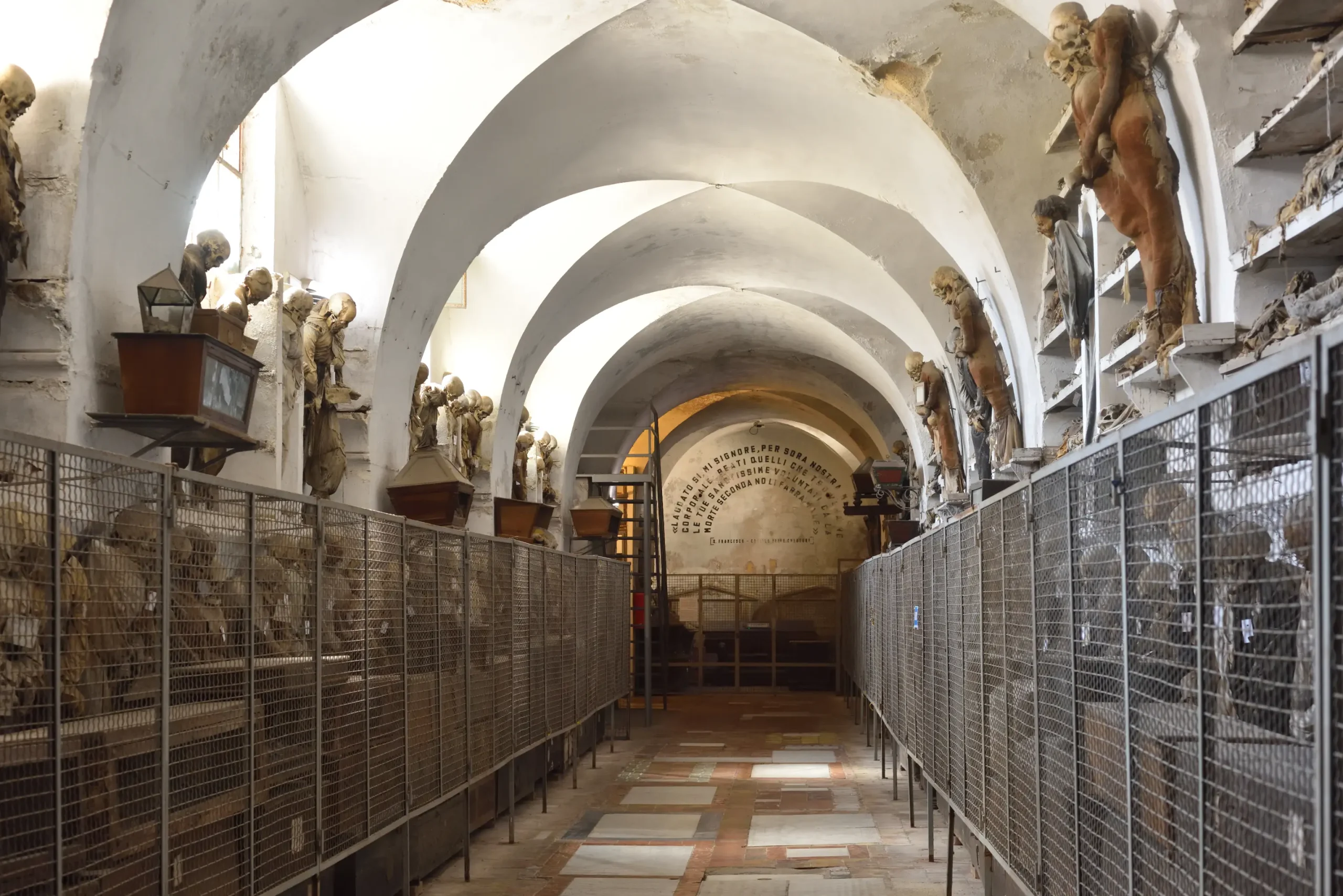
The first body placed in the catacombs belonged to Brother Silvestro of Gubbio, whose naturally mummified remains convinced the Capuchin order that their underground chambers possessed preservation properties worth documenting. The friars had been seeking a dignified solution to cemetery overcrowding when workers broke through tufa bedrock beneath the monastery in 1599 and found chambers with constant airflow and low humidity. The Palermo catacombs evolved from monastic necessity into civic institution over two centuries. By the mid-1600s, wealthy Palermitans petitioned for interment rights, viewing placement in the crypts as posthumous status. Families paid fees to secure corridor space and funded the desiccation process, which involved draining bodies in ceramic chambers called colatoi for eight months before dressing and positioning them in wall niches or standing alcoves. The monastery maintained detailed registries recording each person's profession, death date, and corridor assignment. Sicilian mummification practices reflected broader Mediterranean traditions but developed distinct protocols at the Palermo site. Embalmers working for the Capuchin order used vinegar washes and occasionally arsenic treatments to enhance preservation, though most bodies mummified through environmental conditions alone. The corridors were segregated by social category: friars occupied the original passages, professionals and clergy filled later extensions, and women and children received separate chambers added in the 1700s. Rosalia Lombardo, interred in 1920 through special permission, marked the final addition. Visitors entering today at Piazza Cappuccini walk the same tunnels 17th-century Palermitans used for memorial visits, when families would gather before preserved relatives on feast days. The conservation fee of 5 EUR supports ongoing climate control that protects what natural tufa once accomplished. The capuchin catacombs history guide preserved in monastery archives documents nearly 1,300 individuals by name, though an estimated 8,000 bodies rest in the corridors. Understanding how the crypts developed explains why the layout feels more like a neighborhood than a cemetery—because for two centuries, it functioned as both.
“The first body placed in the catacombs belonged to Brother Silvestro of Gubbio, whose naturally mummified remains convinced the Capuchin order that their underground chambers possessed preservation properties worth documenting.”
The capuchin catacombs history begins in 1599, when the Capuchin friars of Palermo outgrew their original cemetery beneath the monastery chapel. Brother Silvestro of Gubbio became the first friar preserved in the newly excavated corridors carved into the tufa rock beneath Piazza Cappuccini. The friars discovered that the natural airflow and mineral composition of the tufa created conditions that naturally mummified bodies rather than allowing decomposition. This accidental preservation transformed what had been intended as a simple burial vault into something unprecedented. By the mid-seventeenth century, word of the preservation phenomenon spread beyond the monastery walls. In 1652, the first lay burial took place when a prominent Palermitan nobleman secured permission to inter a family member among the friars. The catacombs expanded rapidly throughout the 1600s and 1700s as Palermo's aristocracy, clergy, and professional classes sought eternal rest in the underground chambers. Bodies were placed in niches along the corridors, arranged by social status and profession—priests in one gallery, noblemen in another, virgins in a third. The friars refined their preservation techniques during this period, treating bodies with vinegar washes, draining fluids, and drying corpses in specialized cells called colatoi for eight months before final placement. The practice continued until 1881, when Italian authorities prohibited new burials as hygiene standards modernized across the newly unified nation. The final interment was two-year-old Rosalia Lombardo in 1920, preserved through a then-secret embalming formula that rendered her body remarkably lifelike. Today, visitors walking the dimly lit corridors encounter approximately 1,252 mummified remains still displayed in their original niches and alcoves. The preservation varies—some figures retain clothing and recognizable features, while others show skeletal decay. The galleries maintain the nineteenth-century arrangement by social category, offering a cross-section of Palermitan society frozen across three centuries of burial custom.
Brother Silvestro of Gubbio becomes the first friar buried in newly excavated tufa corridors beneath the Capuchin monastery.
The monastery permits the first lay burial, opening the catacombs to Palermo's aristocracy and wealthy citizens.
Expansion phase sees systematic excavation of new galleries, with bodies arranged by social class and profession.
Friars formalize preservation techniques including vinegar treatment and eight-month drying in specialized colatoi chambers.
Italian authorities prohibit new burials in the catacombs as part of national public health reforms.
Rosalia Lombardo, age two, receives the final interment using an advanced embalming formula that preserves her features.
The site transitions to a museum and pilgrimage destination, with conservation efforts protecting the 1,252 mummified remains.
To experience the site with the necessary quiet for historical reflection, the best arrival window is 09:00–12:10. Arriving during this morning period allows visitors to avoid afternoon crowds and the daily midday closure.
—
Visiting early on weekdays provides a somber, quiet atmosphere for studying the site history.
Mild 18°C to 22°C
Spring and autumn offer comfortable temperatures for walking to the site.
Hot 30°C to 35°C
Summer months see larger groups; plan for early entry to avoid heat and congestion.
Verdict: The best time to visit is weekday mornings between 09:00 and 12:10 during the months of April or October.
The Capuchin Catacombs are open daily to visitors throughout the week. Please note the site observes a consistent midday closure period.
Everything you need to know about capuchin catacombs history
The capuchin catacombs history began in 1599 when friars discovered that the local soil and air possessed natural mummification properties. This led to the preservation of bodies, which were originally intended only for friars before becoming a status symbol for the local elite. Understanding capuchin catacombs history helps visitors appreciate how these underground corridors transitioned from a private religious burial site to a public memorial. Exploring this Palermo landmark provides deep insight into 17th-century funeral customs and social hierarchy.
Visiting the Catacombe dei Cappuccini is a solemn experience involving preserved human remains, which may be distressing for younger children. While there is no formal age restriction, parents should consider the sensitive nature of the site before bringing minors. It is recommended to discuss the nature of the capuchin catacombs history with them beforehand to ensure they are prepared for the environment.
The entrance fee is 5 EUR per person, which serves as a conservation fee to help maintain the site. This fee is collected at the entrance to support the ongoing preservation of the fragile mummies and the historic structure. Please note that payments are typically handled in person upon arrival.
The crypts are open daily from 09:00–12:30 and 15:00–17:30. These hours apply Monday through Sunday, allowing for consistent access throughout the week. Be sure to plan your visit according to these scheduled daily closures.
The best arrival window is 09:00–12:10 to avoid afternoon crowds and the midday closure break. Arriving early in the morning allows you to navigate the narrow corridors more comfortably. This timeframe is ideal for those interested in a quieter experience at this historical site.
Photography is strictly prohibited within the burial corridors to respect the dignity of the deceased and the sanctity of the site. Visitors are asked to keep cameras and mobile phones stored while viewing the preserved remains. This policy ensures the focus remains on the historical and religious significance of the capuchin catacombs history.